
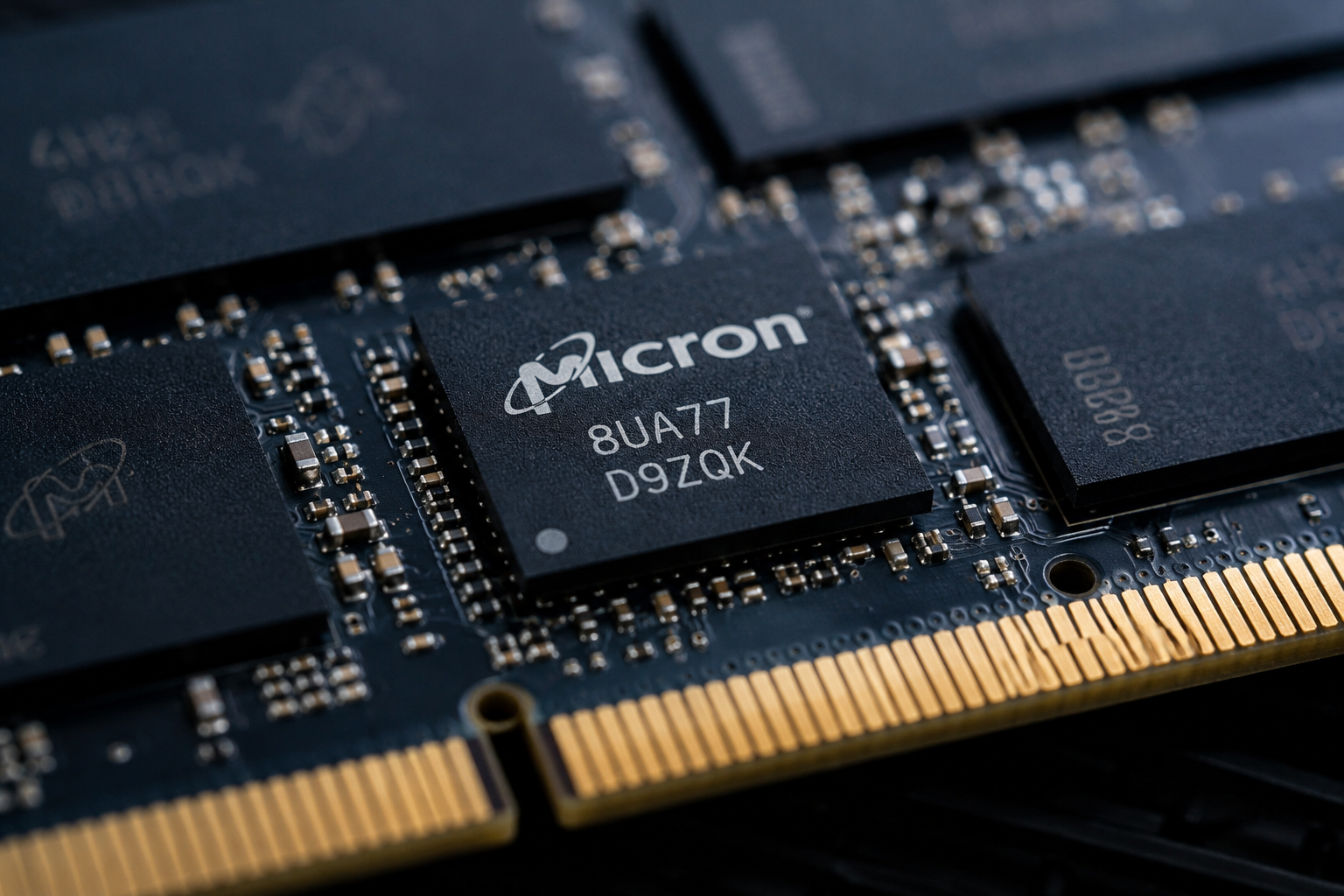
Micron Technology (MU) shares held firm in premarket trading on Wednesday, even as South Korean memory giant SK Hynix suffered a sharp selloff following its second-quarter earnings.
The move suggests investors may be distinguishing between short-term earnings disappointment and the longer-term outlook for artificial intelligence-driven memory demand.
SK Hynix shares plunged more than 9% in Seoul after the company reported record quarterly earnings and revenue but failed to meet the exceptionally high expectations that had been built into one of the market’s biggest AI beneficiaries.
The weakness spread across South Korea’s semiconductor sector, with Samsung Electronics falling more than 5% and dragging the broader Kospi index sharply lower.
Yet Micron, the largest US memory-chip maker, largely escaped the selling pressure.
Its shares fluctuated between modest gains and losses in premarket trading on Wednesday, and were up about 0.5% around 7:25 am ET.
After two days of heavy selling, some investors appeared to buy the dip, helping keep Micron shares relatively resilient.
Investors appear to be buying the dip
Micron has lost about 13% over the past five trading sessions and roughly 28% over the last month, although the stock remains about 160% higher for the year.
The recent decline has prompted several analysts to argue that investors are overreacting to concerns surrounding AI infrastructure spending.
Kumquat Research on Seeking Alpha on Wednesday upgraded Micron from Buy to Strong Buy, arguing that the recent weakness presents a buying opportunity rather than signalling deterioration in the company’s business.
The analyst pointed to Micron’s latest quarterly guidance, noting that the company projected fourth-quarter revenue of $50 billion, gross margins of 86%, and adjusted earnings per share of $31, all comfortably ahead of Wall Street expectations.
According to the analyst, the AI boom has fundamentally altered the industry’s earnings profile.
“Because of the AI supercycle, the company is earning a decade’s worth of profits in just one quarter,” the report said.
AI demand continues to outpace supply
While semiconductor companies continue investing heavily in new manufacturing capacity, analysts argue that memory demand is still growing faster than supply.
Capital expenditure is accelerating across Micron, Samsung Electronics, and SK Hynix, but new fabrication facilities require years to build and ramp up production.
As a result, the market continues to face constrained supplies of advanced memory products required for AI servers.
The analyst argued that the recent correction has done little to alter the industry’s underlying fundamentals.
“In fact, if anything, the demand case has been reaffirmed.”
The report highlighted Nvidia’s recently announced long-term memory supply agreement with SK Hynix, valued at approximately $750 billion, including roughly $500 billion tied to Nvidia and another $250 billion allocated to other US companies involved in AI infrastructure.
It also pointed to Alphabet’s latest earnings, where the Google parent increased its 2026 capital expenditure guidance to roughly $200 billion, reinforcing expectations that hyperscalers continue expanding AI infrastructure despite investor concerns about returns.
The conclusion, according to the report, is that demand remains robust while supply remains tight, making the recent correction more reflective of changing investor sentiment than weakening industry fundamentals.
SK Hynix’s miss masks a strong quarter
Despite the market reaction, SK Hynix delivered one of the strongest quarters in its history.
Operating profit surged more than sixfold from a year earlier to a record level, supported by booming demand for high-bandwidth memory used in AI systems.
However, revenue and operating profit still fell short of elevated analyst forecasts.
The company said delays in shipments of certain advanced products weighed on pricing gains for its core DRAM business.
Melvin, an AI analyst at Milk Road AI, argued that investors had focused too heavily on the earnings miss while overlooking the broader picture.
“The headline numbers aren’t pretty, but revenue came in at $54.6B against estimates of $57.7B, a miss of about 5.4%, and operating profit landed at $41.6B versus the $44.2B expected, even with a still massive 76.3% operating margin. But here’s why I’m not losing sleep over it…,” he said.
He noted that average selling prices for DRAM rose roughly 30% quarter over quarter, while NAND flash prices climbed by the mid-50% range.
“That’s not a company losing pricing power but rather a company still riding one of the strongest pricing cycles memory has ever seen,” he said.
Analysts remain confident in long-term outlook
SK Hynix also projected mid-20% annual DRAM demand growth next year and high-teen growth for NAND memory.
Management added that smartphone and PC shipments were constrained largely because manufacturers could not obtain sufficient memory supplies, rather than because end-market demand had weakened.
Melvin said that distinction was crucial.
“That’s a supply constraint story, not a demand problem and supply constraints are exactly what keeps pricing power intact.”
He added that major cloud companies continue expanding AI infrastructure and increasing memory procurement, while SK Hynix already has long-term supply agreements with ten customers.
“Hyperscalers aren’t pulling back, they’re fighting each other for the same limited memory supply.”
“A miss against inflated estimates during a supply constrained, price surging market is a very different animal than a miss because nobody wants the product,” he concluded.
Industry analyst Patrick Moorhead, chief executive of Moor Insights & Strategy, also dismissed concerns over the earnings miss.
“I think we’ve lost our minds to think that this performance wasn’t a blowout performance,” he wrote on X.
“Revenue +257% and profits +557% and this is bad? Estimates are BS when you are in mega growth.”
“The decade-long AI build out thesis still stands,” he added.
The post Why is Micron stock rising today despite SK Hynix’s earnings-led selloff? appeared first on Invezz