
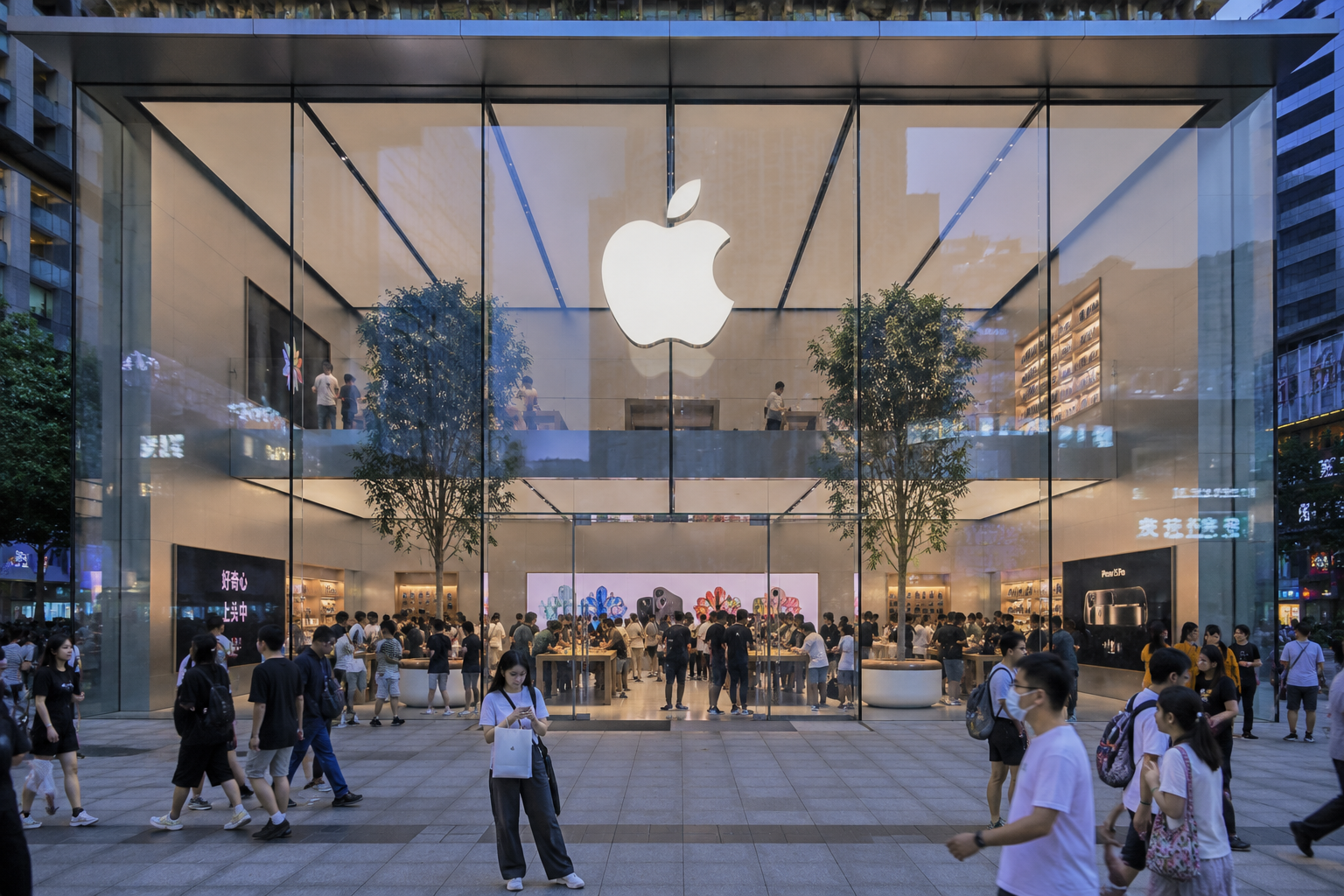
Apple briefly became only the second publicly traded company in history after Nvidia to cross a $5 trillion market capitalisation on Tuesday, in a reflection of investors’ growing preference for technology companies that can deliver earnings growth without committing hundreds of billions of dollars to artificial intelligence infrastructure.
The iPhone maker’s AAPL shares rose as much as 1.8% during the session to touch $342.89, giving the company a market value of approximately $5.036 trillion.
The stock later pared gains to trade about 0.6% higher at $338.88, valuing the company at roughly $4.98 trillion.
The milestone came less than a year after Apple first crossed the $4 trillion mark in October 2025 and just one day after it overtook Nvidia to reclaim its position as the world’s most valuable publicly traded company.
The achievement was particularly notable because it came on a day when broader technology stocks remained under pressure.
The Nasdaq 100 slipped about 0.8%, while the Philadelphia Semiconductor Index dropped more than 4% as concerns over AI-related financing arrangements and memory-chip competition continued to weigh on investor sentiment.
Investors rotate toward Apple’s AI-light strategy
Unlike many of its biggest technology rivals, Apple has largely avoided the expensive race to build AI data centres, a strategy that is increasingly attracting investors as questions mount over the returns from massive infrastructure spending.
Microsoft, Alphabet, Amazon and Meta have collectively committed hundreds of billions of dollars to AI infrastructure, leading to growing concerns about cash flow pressure and longer payback periods.
Apple, meanwhile, has taken a different approach by relying more heavily on partnerships for artificial intelligence capabilities rather than building every component internally.
After initially struggling to develop its own large AI models, the company has leaned on Google’s technology to power services such as its revamped Siri, allowing it to introduce AI features without making the same level of capital commitments as rivals.
That strategy, once viewed as a competitive disadvantage, is now being reassessed by investors.
“There’s a battle in the market, and right now Apple is benefiting because it isn’t in the storm that the rest of the AI trade is in,” Mark Bronzo, chief investment strategist at Rye Strategic Partners, told Bloomberg earlier this month.
“People are concerned about what kind of return hyperscalers could get from their AI spending, and there are also arguments that semis have gotten ahead of themselves. As a result, investors have gravitated back to Apple as a steady-eddy name without those risks.”
The rotation has helped Apple significantly outperform its largest technology peers this year.
Apple shares have gained about 25% in 2026, compared with Nvidia’s roughly 4% advance.
Meta has fallen about 9%, Amazon has risen about 2%, Alphabet is up roughly 5%, while Microsoft has declined more than 15%.
Pricing strategy and leasing programme support demand
Apple’s recent product strategy has also contributed to investor optimism.
Last month, the company chose to keep iPhone prices unchanged while increasing prices for MacBooks and iPads to accommodate rising memory costs.
This move gave rise to questions of demand getting hit.
JPMorgan analyst Samik Chatterjee, however, recently raised his price target to $345, arguing that previous pricing actions have shown little long-term impact on demand.
“Long-term trends suggest that pricing has limited implications on volume opportunity over a multi-year period,” Chatterjee wrote in a July 7 research note.
“Apple has taken meaningful pricing across the portfolio in the past, and volumes have continued to expand despite those price increases.”
The company also unveiled a new US device leasing programme through Klarna on Tuesday.
Under the scheme, customers can lease an iPhone from $17.99 per month, an Apple Watch or iPad from $11.99 per month, and a Mac from $24.99 per month.
Analysts believe the programme could make premium Apple devices more accessible without requiring outright price reductions.
“Apple has resisted the AI spending race, betting that customer experience – not infrastructure investment – will ultimately determine the winners,” said Dipanjan Chatterjee, vice president and principal analyst at Forrester, in a Reuters report.
“The new leasing program is a clever response: it doesn’t reduce the price of an iPhone, but it changes how consumers perceive the cost by replacing sticker shock with a predictable monthly payment.”
Wall Street remains optimistic ahead of earnings
Analysts have also become increasingly upbeat ahead of Apple’s fiscal third-quarter results later this month.
Citigroup recently reiterated its Buy rating while raising its price target to $365, citing continued market share gains and resilient premium demand.
The brokerage expects Apple to increase iPhone prices during the September launch cycle, particularly for higher-end models, while viewing Apple Intelligence as a longer-term driver for services revenue rather than an immediate catalyst for a major upgrade cycle.
Several other firms, including Bank of America, Evercore ISI, Morgan Stanley, Tigress Financial, Wedbush and HSBC, have also raised their price targets into a range of $330 to $400.
Not everyone is convinced the rally can continue.
KeyBanc maintained its Underweight rating with a $250 price target, arguing that slowing unit growth and softer upgrade cycles could eventually weigh on services revenue.
The brokerage also warned that Apple’s valuation has become increasingly demanding.
According to KeyBanc, the stock trades at roughly 37 times its fiscal 2027 earnings estimate, a multiple that leaves little room for operational missteps.
Still, for now, investors appear willing to pay a premium for Apple’s combination of consistent earnings growth, resilient consumer demand and a more measured approach to artificial intelligence investment at a time when much of Big Tech is facing growing scrutiny over the costs of the AI race.
The post Apple briefly hits $5T valuation as investors favour its AI-light strategy appeared first on Invezz