
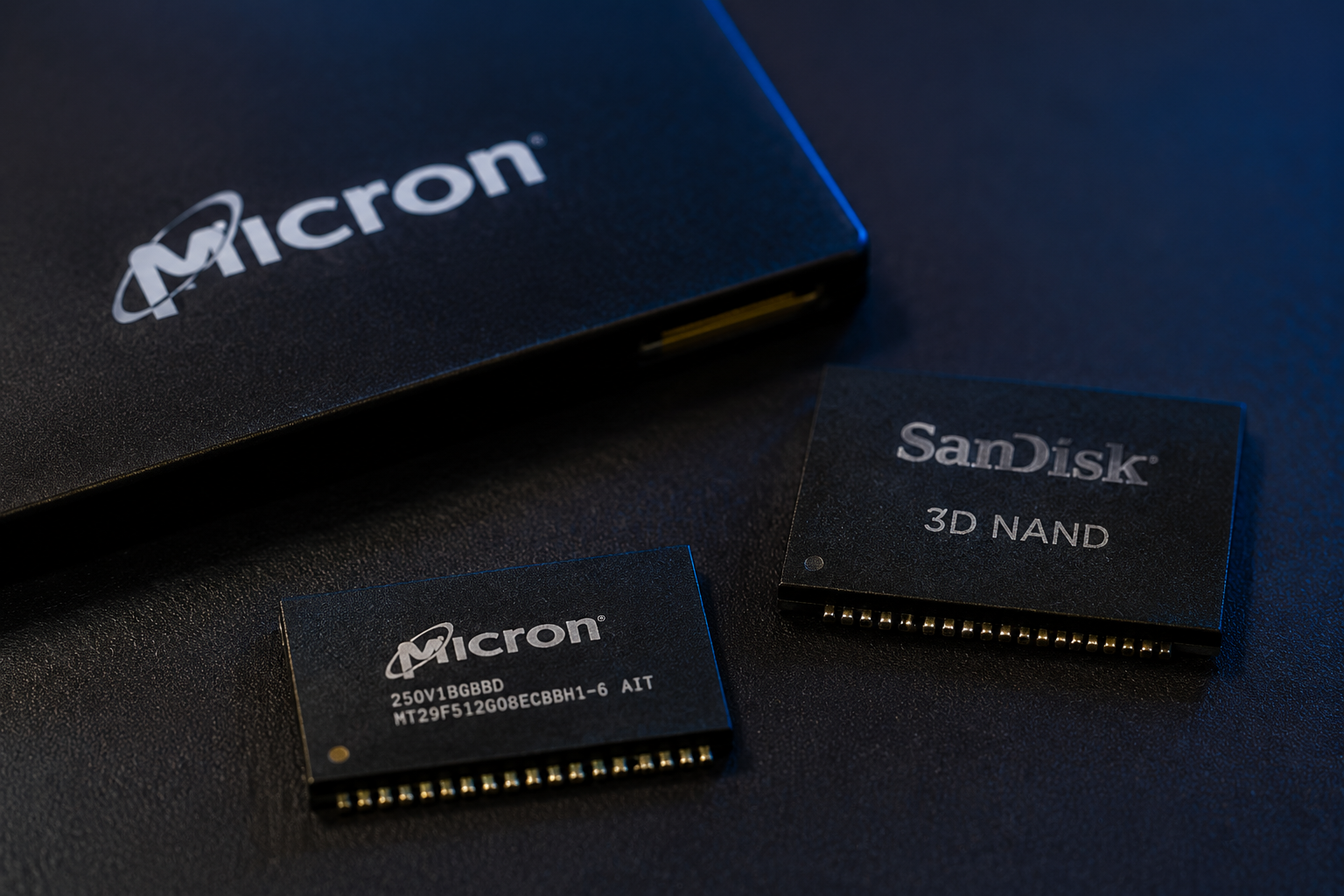
Micron Technology MU shares fell more than 8% on Wednesday as a broad selloff in semiconductor stocks gathered pace, with investors locking in profits after a record first half for the sector.
At the same time, a fresh class-action lawsuit targeting major memory chipmakers added to the pressure.
The decline was part of a wider retreat across chip stocks.
SanDisk dropped more than 10%, Advanced Micro Devices lost about 5%, Nvidia fell over 2%, and Seagate Technology declined more than 6%.
The Nasdaq Composite was down more than 0.4% as investors rotated out of technology names after months of strong gains.
The VanEck Semiconductor ETF, which had surged 72% during the first six months of the year for its strongest first-half performance since launching in 2000, fell more than 4.7% on Wednesday.
Micron has been among this year’s standout performers, with the stock rising more than 230% amid surging demand for artificial intelligence-related memory products.
The rally has also attracted significant retail investor participation, contributing to heightened volatility.
Market participants have increasingly questioned whether the rapid gains in memory stocks can be sustained as the industry approaches another expansion phase.
Concerns have also emerged over additional manufacturing capacity planned in South Korea, announced last week, raising fears that the traditionally cyclical memory-chip industry could eventually swing from tight supply to oversupply.
The combination of stretched valuations and profit-taking weighed on the sector, even as analysts continue to forecast healthy long-term demand driven by AI infrastructure spending.
Lawsuit revives scrutiny of DRAM market
Adding to investor caution, Micron has been named alongside fellow memory chipmakers Samsung Electronics and SK Hynix in a US class-action lawsuit alleging the companies deliberately restricted production of conventional DRAM memory chips to inflate prices.
The complaint alleges the three manufacturers reduced output of mainstream DDR3 and DDR4 memory while shifting manufacturing capacity toward higher-margin high-bandwidth memory (HBM), which is used in AI servers and advanced computing systems.
According to the plaintiffs, the industry’s pivot toward AI became a cover for creating an artificial shortage in conventional memory products.
Together, Samsung, SK Hynix and Micron account for roughly 90% of the global DRAM market, giving their production decisions significant influence over industry pricing.
The lawsuit claims prices for conventional DRAM have climbed roughly 700% over the past four years.
The case also revives memories of the industry’s previous legal troubles.
During the mid-2000s, Samsung and Hynix pleaded guilty in a US Department of Justice investigation into DRAM price fixing, paying criminal fines of $300 million and $185 million, respectively.
Micron cooperated with that investigation and avoided a corporate penalty, although one employee later pleaded guilty to obstruction of justice.
While that history may add weight to the latest allegations, legal experts note that proving coordinated supply restrictions remains challenging.
Analysts remain constructive on memory outlook
Despite the lawsuit and the market selloff, analysts continue to project favorable industry fundamentals.
KeyBanc analyst John Vinh noted on Tuesday that contract prices for several standard DRAM configurations rose about 3% in June from the previous month, while NAND flash memory prices increased 2.4%.
“While the industry is building out capacity in response to AI-driven DRAM/HBM demand, meaningful capacity is not expected until 2027, which still will not be meaningful enough to close the gap,” wrote Vinh.
“Given the constrained supply environment, industry production discipline, and outsized data center demand for HBM and DDR5, we anticipate a continued strong demand and positive pricing trends through 2026 for both NAND and DRAM,” he added.
Vinh maintains an Overweight rating and a $1,600 price target on Micron.
Experts also point to Micron’s strategy of securing long-term customer agreements with minimum pricing provisions, which management believes will help keep gross margins “well above” previous cyclical peaks.
Those contracts are expected to account for about 40% of company revenue, with management aiming to increase that proportion over time.
UBS analyst Timothy Arcuri said this suggests Micron believes it can sustain gross margins of 70% to 75%, lower than the roughly 85% reported in its latest quarter but still significantly above its previous peak of about 62% achieved in 2018.
Arcuri maintains a Buy rating with a $1,625 price target, while the average Wall Street target for Micron stands at $1,543, according to FactSet.
The post Why are Micron, SanDisk, and other semiconductor stocks falling today? appeared first on Invezz