
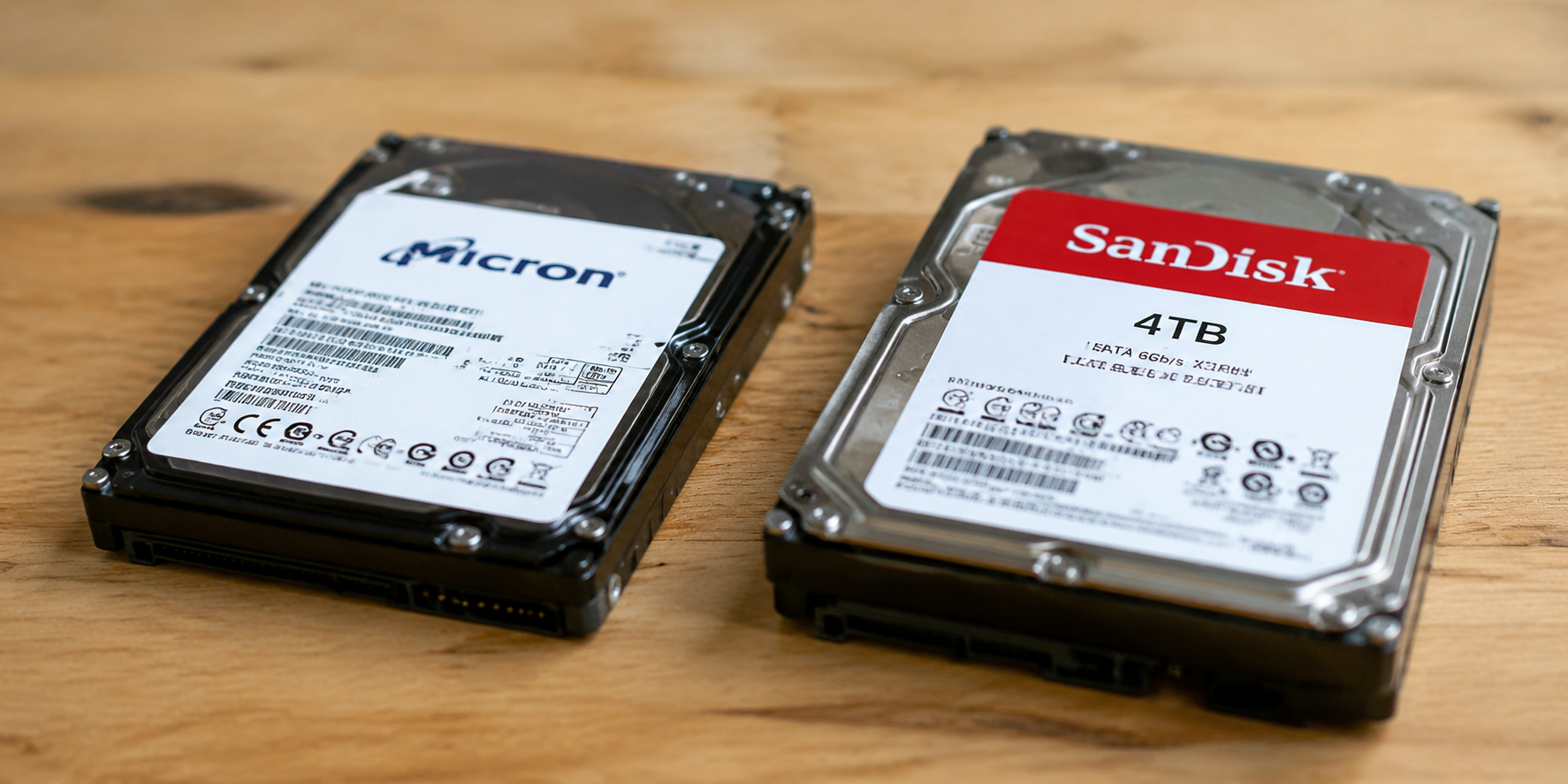
Memory chip stocks came under heavy pressure on Tuesday, extending a broad technology selloff on Wall Street.
Investors grew increasingly uneasy about the enormous sums being poured into artificial intelligence infrastructure and the growing use of debt to finance that expansion.
Shares of memory chipmakers, some of this year’s biggest market winners, suffered steep declines.
Micron Technology MU fell more than 8% in morning trading, while Sandisk tumbled over 10%.
Seagate Technology dropped more than 7% and Western Digital slid over 8%.
The weakness followed a sharp selloff across Asian technology markets earlier in the day.
South Korean memory giants Samsung Electronics and SK Hynix, which together account for roughly half of the benchmark Kospi’s market capitalisation, each fell more than 12%.
The declines marked a sharp reversal for a sector that has been among the biggest beneficiaries of the AI boom.
AI spending concerns move to centre stage
Investors have poured money into memory stocks over the past year, betting that demand for high-performance memory chips used in AI data centres would remain robust for years.
However, analysts say market participants are beginning to question whether the industry’s massive capital spending plans are sustainable.
The latest catalyst for those concerns came from SpaceX.
The company, whose shares plunged 16.4% on Monday after unveiling plans for a major bond sale, has become the latest example of companies turning to debt markets to finance large-scale AI and infrastructure ambitions.
Although SpaceX shares were slightly up on Tuesday, analysts said the bond sale had amplified worries surrounding the broader AI ecosystem.
Ipek Ozkardeskaya, senior analyst at Swissquote, said the company had reignited concerns that technology firms may be spending too aggressively.
“Seemingly, the recent IPO did not suffice to assuage the company’s funding needs, a reminder of how much money may still be burned on the way to Mars,” she said.
Ozkardeskaya noted that Morgan Stanley expects global AI-related borrowing to exceed half a trillion dollars this year, making corporate debt markets increasingly tied to the AI theme.
Valuations leave little room for disappointment
Concerns are spreading beyond individual companies because some of the world’s largest technology firms have collectively committed hundreds of billions of dollars toward building AI infrastructure.
Companies including Alphabet, Amazon, Microsoft, Meta Platforms, and Tesla continue to ramp up investments in data centres and computing capacity, even as investors seek clearer evidence that those spending plans can deliver returns that justify the costs.
Memory stocks have become particularly vulnerable because of their extraordinary gains this year.
Micron shares have surged more than 250% so far in 2026. Sandisk has risen over 639%, while Seagate and Western Digital have gained more than 257% and 260%, respectively.
Such gains have left valuations stretched and increased investor sensitivity to any signs that enthusiasm around AI may be overheating.
Joachim Klement, investment strategist at Panmure Liberum, said the sector had become excessively extended.
“We have seen tech stocks go vertical and become very overbought. What we’re doing now is getting rid of that overbought situation,” Klement said.
He warned that the correction could become more severe if investors increasingly question the sustainability of massive AI spending plans.
“I think a lot of the selloff is also triggered by SpaceX. A lot of retail investors have taken profits, and this news about additional debt piles onto concerns around fundraising across hyperscalers,” he said.
Nigel Green, chief executive of investment adviser deVere Group, told Reuters, “The AI trade became one of the most crowded trades in global markets. When everybody owns the same stocks, the exit door becomes very small very quickly.”
Higher rate expectations add to pressure
Technology stocks are also contending with a less favourable interest-rate environment.
According to CME’s FedWatch Tool, traders now see an 88% probability of a Federal Reserve rate increase in December, sharply higher than the 61% probability seen before the central bank’s meeting last week.
The prospect of higher borrowing costs poses an additional challenge for highly valued technology companies, particularly those dependent on large amounts of capital to fund ambitious AI infrastructure projects.
The post Micron, Sandisk, other memory stocks tumble on high AI spending and rate hike fears appeared first on Invezz