
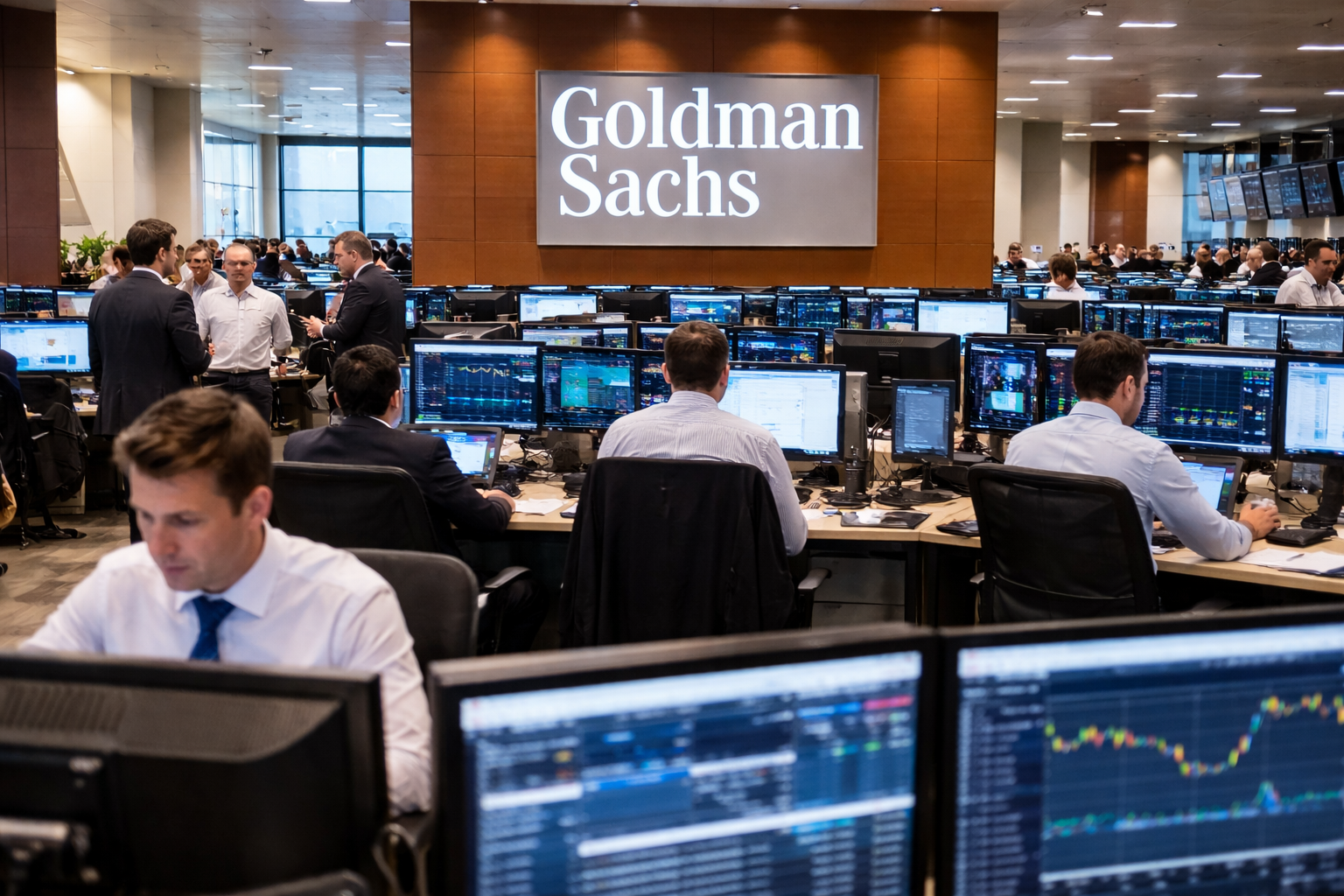
Shares of Goldman Sachs fell more than 4% in premarket trading despite the Wall Street giant reporting a strong first-quarter performance, as investors focused on weaknesses in parts of its business and a more uncertain outlook.
The bank said profit rose 19% in the first quarter, supported by a rebound in dealmaking and heightened market volatility that boosted its core banking and markets division.
However, the market reaction suggested expectations had been even higher.
Strong dealmaking and equities trading drive growth
Total revenue for the quarter ended March 31 rose 14.4% year-on-year to $17.23 billion, exceeding the average analyst estimate of $16.99 billion compiled by FactSet.
Global banking and markets revenue climbed 19% to $12.74 billion, ahead of the $12.13 billion consensus.
Investment-banking fees surged 48% to $2.84 billion, reflecting a pickup in mergers and acquisitions activity.
Equity underwriting revenue jumped 44.6% to $535 million, while net equities revenue rose 27% to $5.33 billion.
The results were underpinned by a wave of deal activity and increased client trading as markets reacted to geopolitical tensions, particularly the Iran war, which has driven volatility across asset classes.
Chief executive David Solomon described the first-quarter earnings report as “very strong,” pointing to the bank’s ability to capitalise on shifting market conditions.
FICC weakness tempers enthusiasm
Despite the strong headline numbers, investors were unsettled by a decline in fixed income, currencies, and commodities (FICC) revenue, which fell 10% to $4.01 billion, below the FactSet consensus of $4.83 billion.
FICC financing revenue rose 5% to $1.01 billion, but intermediation, or market-making revenue, dropped 13% to $2.95 billion.
The decline was driven by lower revenue from interest-rate products, mortgage-related securities, and credit markets, even as commodities trading remained relatively strong.
Axel Rudolph, chief technical analyst at IG, said the results failed to “pique investors’ attention,” noting that while performance was solid, it fell short of elevated expectations.
“Goldman Sachs has delivered a solid set of numbers, but in this environment, ‘solid’ isn’t quite enough to keep investors interested. The strength in equities trading and dealmaking shows that the machine is still firing on all cylinders, yet the drop in FICC revenues is a reminder that this is not a one-way street, especially with markets being buffeted by the Iran war,” he said.
High expectations weigh on market reaction
Analysts said the muted market response reflected the high bar set by investors following a strong run in the stock and favourable operating conditions.
“After such a strong run in the share price, investors were clearly looking for something exceptional, not just good,” Rudolph added.
He warned that the results could represent a near-term peak.
“The bigger issue is that Goldman’s results feel like a snapshot of a world that may already be fading,” he said, pointing to rising oil prices, inflation concerns, and recession risks.
In that context, he added, “today’s numbers risk being seen as close to peak earnings,” which may explain why investors chose to lock in gains.
Outlook clouded by macro risks
While the bank benefited from volatility and a looser regulatory backdrop that has supported dealmaking, the outlook remains uncertain.
Rudolph said that with “oil prices surging, inflation fears building and recession risks creeping back in, the outlook for dealmaking and capital markets activity becomes far less certain.”
FICC revenues, in particular, are inherently volatile and sensitive to swings in interest rates, credit markets, and commodities.
This has been especially evident in recent months as energy markets fluctuate amid geopolitical tensions.
Goldman’s transition away from certain consumer-focused initiatives, including its previously announced move to shift the Apple credit card programme to JPMorgan Chase, also reflects a broader recalibration of its strategy toward core institutional businesses.
The post Why is Goldman Sachs stock falling despite blowout earnings? appeared first on Invezz