
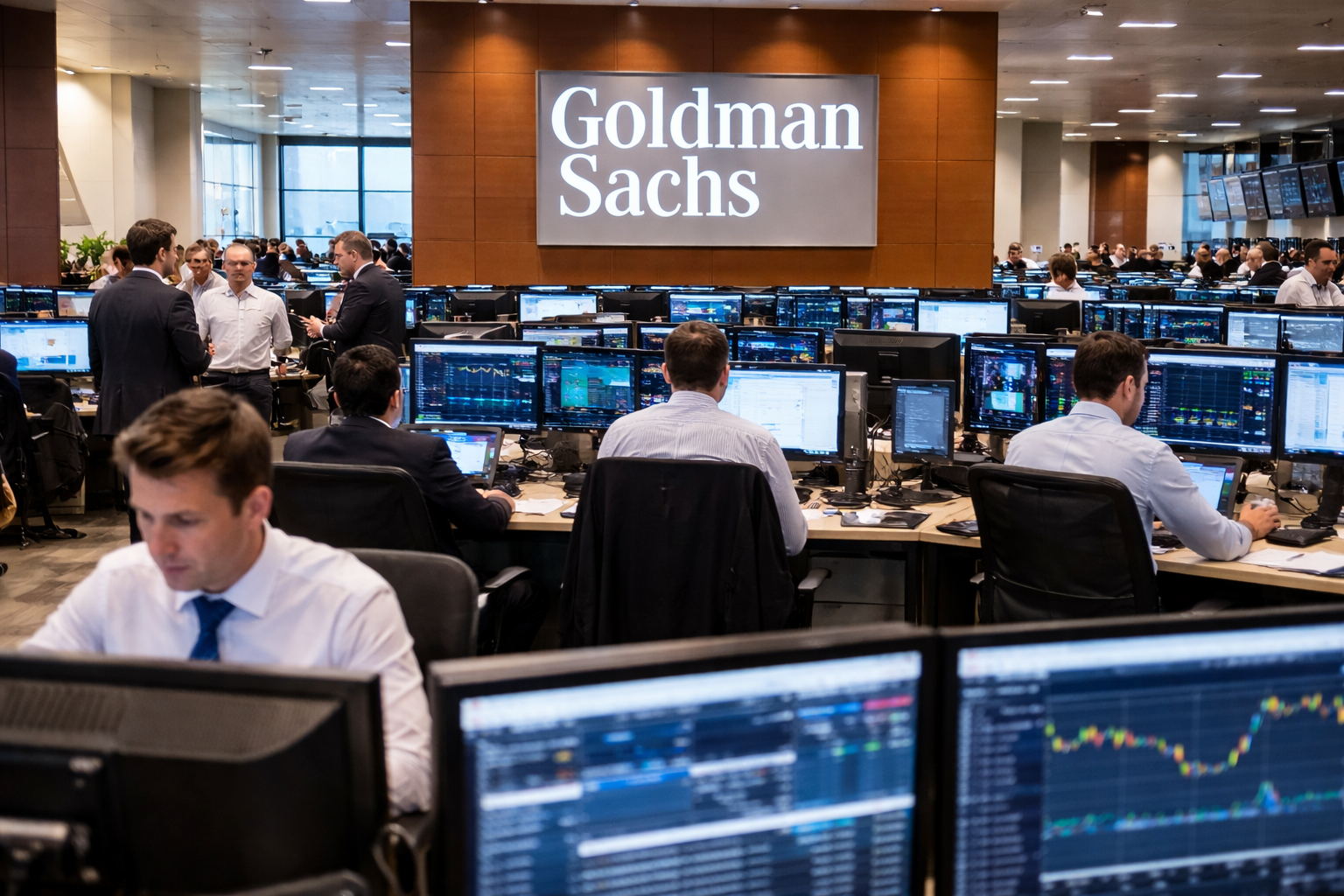
Goldman Sachs reported a 19% increase in its first-quarter profit, as a rebound in mergers and acquisitions activity and strong equities trading powered a near-record performance for its core banking and markets division.
The Wall Street lender said profit applicable to common shareholders rose to [MONEY value=”5400000000″ currency=”usd” notation=”long” replace=”false”], or $17.55 per share, compared with [MONEY value=”4580000000″ currency=”usd” notation=”long” replace=”false”], or $14.12 per share, a year earlier.
It marked the bank’s second-best quarter ever for overall profit and revenue, trailing only the first quarter of 2021.
Revenue rose 14% to [MONEY value=”17230000000″ currency=”usd” notation=”long” replace=”false”], up from [MONEY value=”15060000000″ currency=”usd” notation=”long” replace=”false”] in the same period last year.
The results were underpinned by robust dealmaking and heightened trading activity, as clients navigated volatile global markets shaped by the ongoing Iran war and rising energy prices.
However, the stock was down by 4% post the announcement of the earnings.
Volatility boosts trading desks
Global markets have been roiled by geopolitical tensions, with higher crude oil prices fuelling inflation concerns and raising the spectre of a broader economic slowdown.
This environment has prompted investors to reassess portfolios and hedge risks, driving activity across trading desks.
Goldman’s revenue from equity trading intermediation and financing rose 27% to a record [MONEY value=”5330000000″ currency=”usd” notation=”long” replace=”false”].
However, revenue from fixed income, currencies and commodities fell 10% to [MONEY value=”4010000000″ currency=”usd” notation=”long” replace=”false”].
The surge in equities trading reflects increased client engagement, as investors reposition portfolios amid heightened uncertainty.
Such volatility typically benefits large banks, allowing them to generate fees from facilitating transactions across stocks, bonds and derivatives.
“The geopolitical landscape remains very complex – so disciplined risk management must remain core to how we operate,” Goldman Sachs CEO David Solomon said in a statement.
Deal activity rebounds sharply
A revival in global dealmaking also contributed significantly to Goldman’s performance.
Investment banking fees rose to [MONEY value=”2840000000″ currency=”usd” notation=”long” replace=”false”] in the first quarter, a 48% jump from a year ago.
Global M&A volumes reached [MONEY value=”1380000000000″ currency=”usd” notation=”long” replace=”false”] during the quarter, according to Dealogic data, highlighting a resurgence in corporate activity despite geopolitical headwinds.
Analysts at Jefferies said global M&A proxy fees climbed 19% year-over-year to [MONEY value=”11300000000″ currency=”usd” notation=”long” replace=”false”], with Goldman leading in market share.
The bank advised on several high-profile transactions, including Unilever’s planned merger of its food business with McCormick to create a [MONEY value=”65000000000″ currency=”usd” notation=”long” replace=”false”] company, and Equitable’s proposed tie-up with Corebridge to form a [MONEY value=”22000000000″ currency=”usd” notation=”long” replace=”false”] insurer.
The deal pipeline has been supported by a combination of a growing economy, significant investments in artificial intelligence, and expectations of a softer regulatory stance under President Donald Trump’s administration.
Outlook tempered by geopolitical risks
Looking ahead, Wall Street executives expect a strong year for mergers and acquisitions, with private-equity firms seeking to exit investments and a number of large technology companies preparing to go public, including SpaceX and Anthropic.
However, uncertainties remain.
Investors have grown cautious about banks’ exposure to private credit and broader macroeconomic risks, contributing to pressure on banking stocks in recent months.
There are also concerns that escalating tensions in the Middle East could push inflation higher and dampen dealmaking activity if economic conditions deteriorate.
Despite these risks, the current environment of elevated volatility and sustained corporate activity continues to provide a supportive backdrop for investment banks, particularly those with strong trading and advisory franchises.
The post Goldman Sachs Q1 profit jumps 19% on M&A boom, trading amid market volatility appeared first on Invezz