
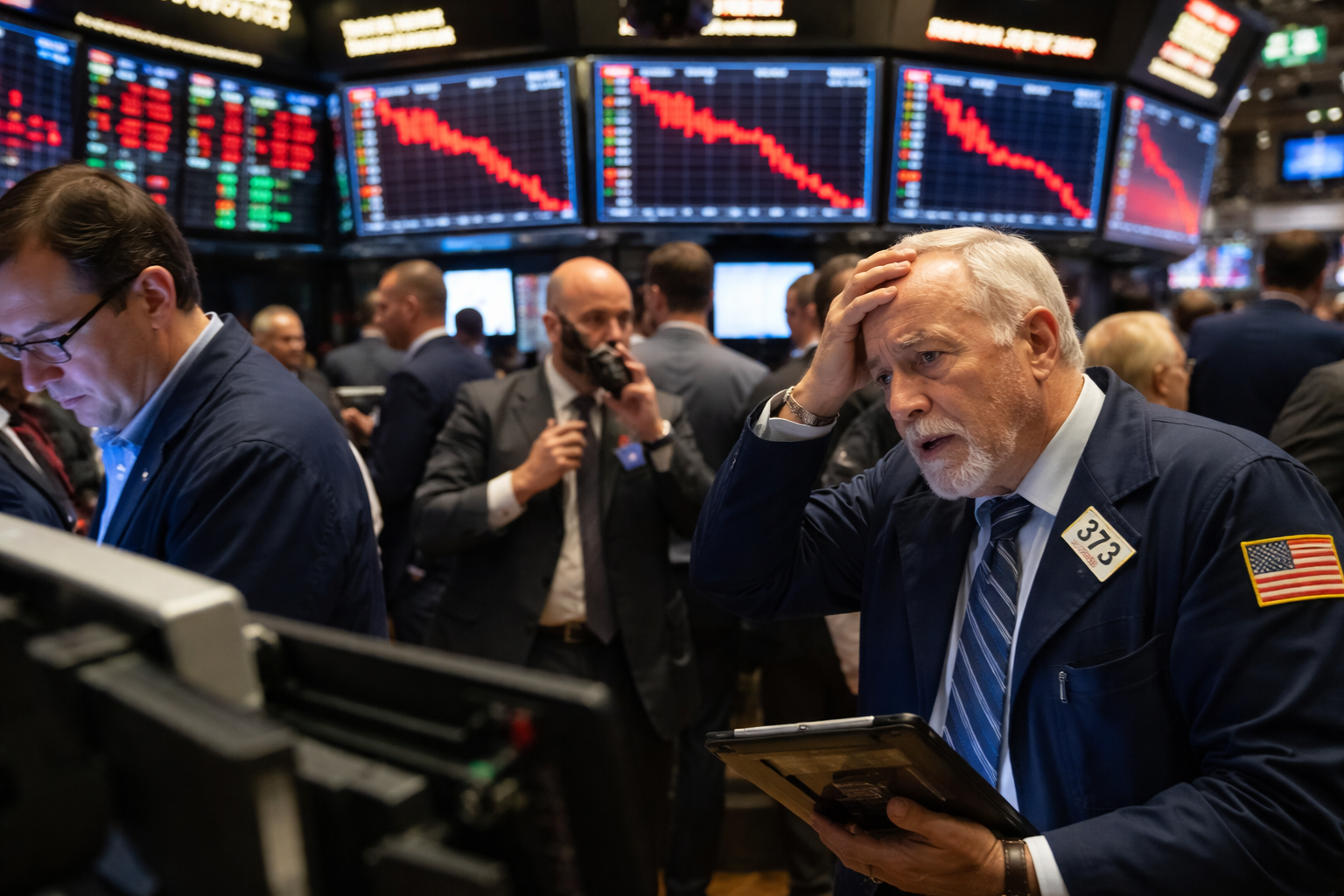
It’s only March, and investors have already absorbed a hot war in the Middle East, a credit system showing cracks, a brutal tech repricing, and two of the world’s most trusted safe-haven assets selling off in the middle of a crisis.
The market feels chaotic because it genuinely is, and what makes this moment unusual is that the five risks feeding that chaos are not independent.
They are connected, amplifying each other in ways that make the standard playbook harder to trust.
Is the Iran war already priced in?
This is the hardest question for investors today.
The US-Israel strikes on Iran began on February 28.
Within days, Brent crude hit $120 a barrel. Iran’s response — closing the Strait of Hormuz — suspended roughly 20% of global oil and LNG supply overnight.
Iraq, Kuwait, Saudi Arabia, and the UAE collectively lost at least 10 million barrels per day of export capacity. That is the largest supply disruption in the history of the global oil market.
Oil has since pulled back to around $108–112, with Trump signalling a desire for a swift end to hostilities and Netanyahu declaring Iran’s nuclear capability destroyed.
But the physical damage to infrastructure doesn’t heal on a diplomatic timeline.
Damaged refineries, blocked shipping lanes, and Qatar’s LNG force majeure could take weeks or months to fully resolve.
Seasoned analysts forecast Brent easing to $70–80 by year-end. Their bull-case is $150. Saudi officials have privately floated $180 if disruptions extend into late April.
The single most important market catalyst available right now is a credible resumption of tanker traffic through the Strait. Everything else is secondary.
The $3-trillion credit system is quietly gating
While oil dominates the headlines, a more structurally dangerous story is unfolding in private credit — and it is getting a fraction of the coverage it deserves.
Blackstone’s flagship credit fund received $3.8 billion in withdrawal requests in a single quarter, forcing executives to inject $400 million of their own capital to meet them.
BlackRock restricted withdrawals on its $26 billion lending fund.
Morgan Stanley received repurchase requests for 10.9% of shares in its largest private income fund. Cliffwater faces requests exceeding 7% of its $33 billion flagship.
These are not isolated incidents because they are the same event happening simultaneously across the industry’s biggest names.
The default rate tells the deeper story. Fitch Ratings puts US private credit defaults at a record 9.2% — more than double the 4.5% rate in publicly traded loans.
UBS estimates that 25–35% of private credit portfolios carry elevated AI disruption risk, concentrated in technology and business services lending.
These are loans made to the exact companies whose revenue models are now being questioned by the rise of AI agents.
JPMorgan has already gone through its financing portfolio name by name, marking down loans with software exposure.
Regional banks carry an estimated $100–150 billion in exposure to the funds now gating withdrawals.
Hedgeye’s best historical analogy is not 2008 but 2001–02 — a crowded credit thesis, built around telecom then and software now, unwinding slowly over two to three years.
Why are SaaS stocks down 20% this year?
The market has stopped rewarding AI ambition and started demanding AI margin — and the gap between the two is punishing.
The S&P 500 Software & Services Index is down 20% year-to-date. Workday is off 39%.
Salesforce has fallen 27%. Oracle is down 20%. NVIDIA is already 11% below its October 2025 highs.
The sell-off reflects a genuine structural question: can AI agents replace enterprise software seats, or will they enhance them?
If an AI agent can handle 80% of a company’s CRM workflows at a fraction of the cost of 200 Salesforce licences, the per-seat model erodes from below.
Not because the software disappears, but because enterprises stop renewing at the same scale.
The Magnificent 7 face a related but distinct problem, which is the capex bill.
Microsoft alone is projected to spend $107 billion on AI infrastructure this fiscal year.
Across the hyperscalers, global AI spending runs at roughly $650 billion annually.
That capital needs to generate measurable margin expansion in the next two to three quarters, not in five years.
The Shiller CAPE ratio sits at around 38x and is in the top 10% of valuations since 1988. The market is priced for near-perfect execution.
Why is Gold falling during a war?
Gold was at $5,000 last week. It is now trading around $4,495, down roughly 10% in days, and down 8.6% since the Iran war began.
This is one of the most counterintuitive market events in years.
The mechanism, however, makes sense.
The Iran war spiked oil, which spiked inflation, which forced the Fed to hold rates at 3.5–3.75% on March 18 with a hawkish signal. Only one cut is projected for all of 2026.
A hawkish Fed strengthens the dollar.
A stronger dollar depresses gold. Simultaneously, investors who rode gold’s extraordinary 65% surge in 2025 are liquidating positions to cover margin calls elsewhere.
The same dynamic is crushing Bitcoin, now trading at $69,000, 45% below its October all-time high of $126,198.
The result is that cash is the only safe haven actually working, for now.
US money market funds just hit a record $8.27 trillion in assets.
Nevertheless, JPMorgan’s year-end gold target remains $6,300. Deutsche Bank holds at $6,000.
Both describe the current weakness as a forced-liquidation event inside a structural bull market and not a verdict on gold’s long-term role.
But for now, the traditional diversification toolkit is misfiring, and the only thing definitively outperforming is sitting in T-bills at 4–5%.
The post Iran war, private credit crunch, and AI reset: inside the global market meltdown appeared first on Invezz